
Preparation and planning can save your business
It is too often the tendency to avoid considering risks until they occur. Let’s face it, it takes budget resources to identify risks and may take even more money and time to adequately mitigate the risk. These actions may seem a distraction when you are engaged in keeping the day-to-day operations going, but a forward-thinking mindset will keep you sustainably profitable.
I had the occasion to be working with a high-tech manufacturer who sourced raw material from two far-flung global sources. The risks were many and included logistical, political, geographic, etc. While not excessively expensive, we developed a mitigation strategy that included a third raw material source along with contract flexibility to adjust volume purchased as needed. No one knew a devastating earthquake would cause the tsunami that hit Japan in 2009 causing significant human tragedy along with disrupting one of their suppliers for many months. With their forward-thinking risk mitigation plan in place, they were able to maintain production levels. What had seemed like an unnecessary expense at the time, prevented millions in losses.
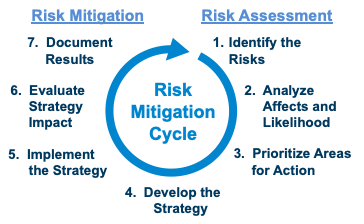
The steps to effective risk mitigation can be described in various ways, but all include:
- Taking action to review all aspects of your business to identify risks.
- Assess the likelihood of occurrence and the effect an occurrence will have.
- Prioritize your risks based upon the assessment.
- With the risk identified and the priority set, you have the data needed to create a mitigation strategy.
- With the strategy set, ensure sufficient resources are deployed to implement the strategy.
- Use the P-D-C-A (Plan, Do, Check, Act) approach to evaluate the effectiveness of your risk mitigation strategy. This approach allows for corrective action based on new information that becomes visible as we progress with the implementation.
- Document the results and make them a visible part of the on-going business plan.
Unfortunately for us all, risks continue to develop and grow with the constant transformation of global and local business operations. This means we should revisit the risk mitigation cycle at regular intervals to keep our companies prepared.
